


Marking the bicentenary of Moritz Grossmann’s birth
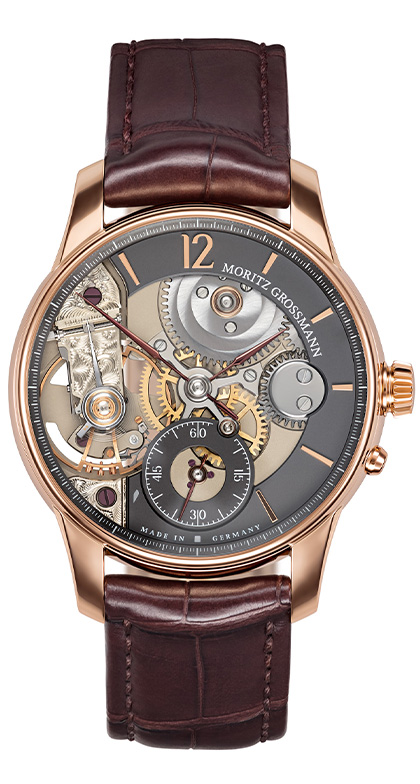
Two sides of the modern era: to mark the 200th anniversary of Moritz Grossmann’s birth, two new versions of the BENU Power Reserve adopt dark colour schemes and give fresh expression to the traditional art of watchmaking.
In 2026, the watch manufactory Moritz Grossmann celebrates the 200th anniversary of its namesake’s birth. Born on 27 March 1826, the watchmaker and founder of the German School of Watchmaking in Glashütte combined traditional craftsmanship with a progressive mindset. The manufactory remains committed to that spirit: in this anniversary year, a series of special-edition models shows how the time-honoured art of watchmaking can be carried into the present day.
Just how modern can traditional watchmaking be? The manufactory’s new
BENU Power Reserve offers two answers. Both versions feature an anthracite-coloured dial with intricate details. Yet each model has a character of its own: in stainless steel the watch reads clean, minimalist and understated, while the second version’s anthracite DLC-coated case gives it a striking, almost avant-garde presence.
In the DLC-coated version, the dark colour scheme offers a fresh perspective on the classic BENU case. The lines and proportions are more pronounced, while the anthracite dial brings out the contrasting surface finishes. The BENU Power Reserve thus combines the traditional Glashütte watchmaking craft with a thoroughly modern, minimalist aesthetic.
Classic design, contemporary style
The striking combination of stainless steel and a dark dial gives the
BENU Power Reserve a clean, elegant look. In the second version, the stainless steel case takes on an anthracite hue. This is achieved with a coating technique known as DLC. The abbreviation ‘DLC’ stands for ‘diamond-like carbon’.
In this technologically advanced process, an ultra-thin, carbon-based layer is vapour-deposited onto the stainless steel in a vacuum. What makes this layer special is its molecular structure, which combines the properties of graphite and diamond. This not only gives the case a sophisticated, dark appearance, but also makes it exceptionally scratch-resistant, robust and durable. Here, Moritz Grossmann brings traditional craftsmanship together with state-of-the-art surface technology.
Experience the mechanism: the power-reserve indicator
At the mechanical heart of the BENU Power Reserve sits the very complication the watch is named after: the indicator showing how much energy the movement still has in reserve – information of real consequence to anyone wearing a mechanical timepiece. With a hand-wound calibre in particular, the wearer has to step in before it runs down and rewind the movement via the crown. That is what the power-reserve indicator tells you, and it is a charming detail in its own right: it brings the mechanism to life and serves as a constant reminder that what sits on your wrist is a piece of fine craftsmanship.
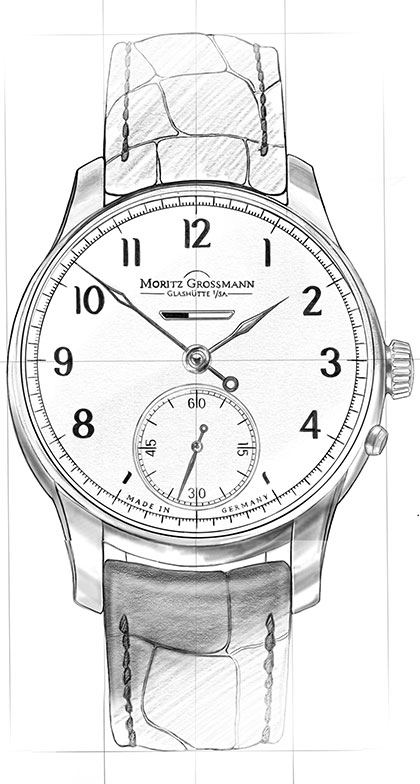
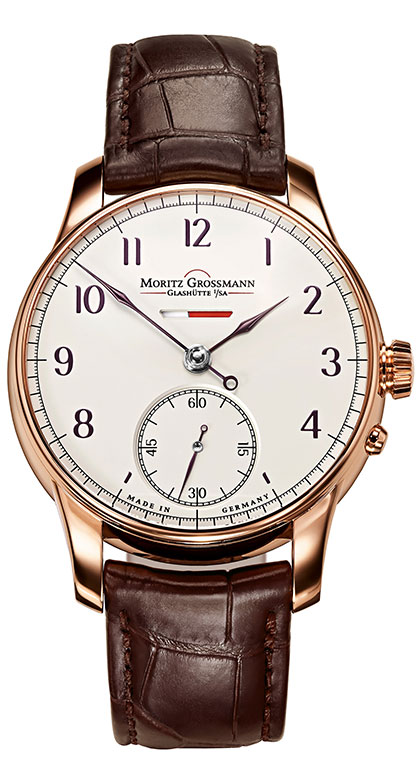
At Moritz Grossmann, the power-reserve indicator is perfectly attuned to the manufactory’s understated, classic design: It is displayed linearly in a small aperture in the dial below the ‘12’, where a bar appears that is controlled by a differential gear. When the movement is fully wound, a completely white bar is visible; as the power reserve decreases, the bar gradually turns black.
In keeping with the design of the new BENU Power Reserve, the power-reserve indicator too is held strictly to black and white.
The dial: interplay of light and texture
The dark anthracite shade lends the dial a fascinating depth, which is further emphasised by the high-contrast finishes. The outer ring, which features the applied numerals and hour markers, stands out from the centre thanks to a delicate circular pattern known as ‘azurage’. The centre has been given a subtle matt finish. Sweeping above it are steel hands, shaped by hand in the manufactory. Their gently rounded, domed form and wafer-thin tips are quietly captivating.
The movement: a calibre 100.2
Working beneath the dial of the BENU Power Reserve is calibre 100.2. It is based on the 100.1 movement, with an additional differential gear added to drive the power-reserve display.
The movement uses the Grossmann manual winder with pusher, a cantilevered balance cock with Grossmann micrometer screw, a separately removable clutch winder and the mass-optimised Grossmann balance.
The sapphire crystal caseback reveals the intricately finished components of the movement – the finest German craftsmanship from the Moritz Grossmann manufactory. The special ‘1826’ engraving on the balance cock marks the year the manufactory’s namesake was born.
Two versions, one signature style
The BENU Power Reserve is available in two versions: with a stainless steel case or with an anthracite-coloured, DLC-coated stainless steel case. In both, the understated design embodies Moritz Grossmann’s classic aesthetic. Characteristic details include the cross grooves on the crown and the slimline strap lugs, between which the supple strap is secured. Both versions of the BENU Power Reserve come on a black strap in soft kudu leather.
The BENU Power Reserve is a limited edition: 18 pieces in each version, stainless steel and DLC-coated stainless steel.
Moritz Grossmann:
Moritz Grossmann, born in Dresden in 1826, was deemed a visionary among Germany’s great horologists. In 1854, his friend Ferdinand Adolph Lange persuaded the young, highly talented watchmaker to establish his own mechanical workshop in Glashütte. Apart from building a respected watchmaking business, Grossmann was committed to political and social causes. He established the German School of Watchmaking in 1878. Moritz Grossmann passed away unexpectedly in 1885, after which his manufacture was liquidated.
The spirit of Moritz Grossmann’s horological traditions sprang back to life in 2008 when trained watchmaker Christine Hutter discovered the venerable Glashütte brand and had it re-registered. She developed concepts and was inspired by the vision of reviving Grossmann’s legacy more than 120 years later with a particularly exquisite wristwatch. And she convinced private watch enthusiasts to support her in making this dream come true. On 11 November 2008, she founded Grossmann Uhren GmbH in Glashütte.
At Grossmann, gifted watchmakers are preserving traditions without copying historic timepieces. With innovation, superb craftsmanship, a combination of traditional and contemporary manufacturing methods as well as precious materials, they are celebrating ‘Schönstes deutsches Handwerk’ with their timepieces.