




Marking the bicentenary of Moritz Grossmann’s birth
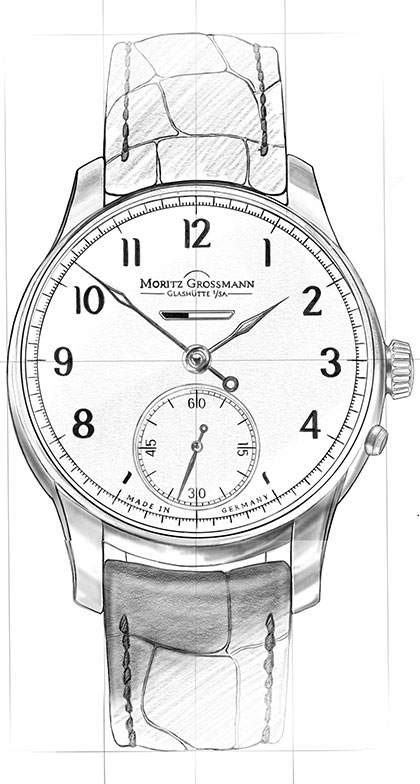
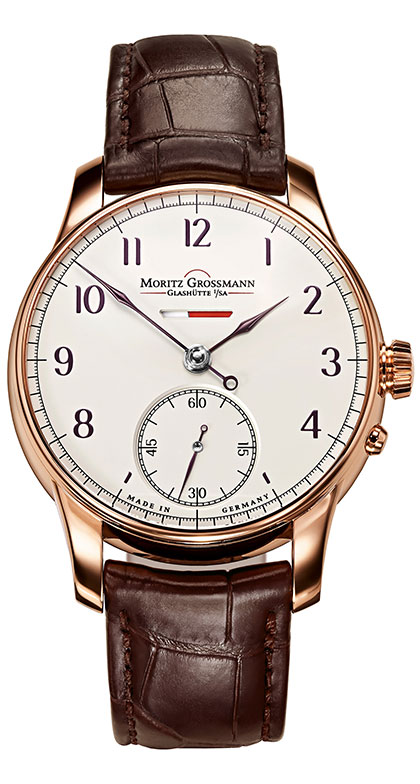
The BENU 1878, the eighth anniversary edition for Moritz Grossmann’s 200th birthday, pays tribute to a landmark in Glashütte’s watchmaking history – the German School of Watchmaking. A stylised view of the historic building adorns the elaborately crafted German silver dial. The BENU 1878 comes in stainless steel and is limited to 26 pieces.
Sometimes a building is more than just stone and architecture. It can shape the face of a town, tell its story and influence how it develops. In Glashütte, the German School of Watchmaking is just such a place.
Few buildings embody Glashütte’s history quite like this one. Here, knowledge was handed down and precision taught, and the school helped shape the future of the craft that made the small Saxon town famous the world over.
The school’s history is closely tied to Moritz Grossmann, who set up his own watchmaking workshop in Glashütte around the turn of the year 1854/1855 and went on to play a major role in the life of the town. Throughout his life, he placed as much importance on learning and teaching – on acquiring knowledge and passing it on – as on his work as a watchmaker, watch manufacturer, author and theorist. It was this commitment that led him to initiate the founding of the German School of Watchmaking in Glashütte.
German School of Watchmaking
Source: German Watch Museum Glashütte
The school opened in 1878. For generations, knowledge was imparted and craftsmanship taught there. In this way, the school was instrumental in establishing the legend of Glashütte as the place where German time is made.
History on the dial
To mark the 18th anniversary of Grossmann Uhren GmbH on 11 November 2026, the manufactory is putting the history of the German School of Watchmaking centre stage with the BENU 1878. A stylised view of the historic building, now home to the German Watch Museum Glashütte, graces the German silver dial.
The design depicts the school’s original main building, which was constructed in the Historicist style and opened in 1881. The stylistic elements typical of that period, which drew inspiration from antiquity and the Renaissance, are evident in the symmetrical window arrangements and moulded cornices.
On the dial, these architectural features become graphic lines that give it an appealing rhythm. In 1923, the building was extended with a striking new wing in the more austere, monumental architectural language of the day. The imposing flight of steps in front of the building also dates from this time. The dial of the BENU 1878 in stainless steel thus also bears witness to how the building has changed over the years.
A historic motif, reinterpreted in three dimensions
The decorative design was created, following numerous trials, using a technique that meets the specific requirements of working with German silver and modelling the motif in relief. The rhythm of the lines and the strict two-tone colour scheme give the image its special appeal. As a result, the dial has a subtle allure that only reveals its full refinement upon closer inspection.
The finest mechanics the manufactory has to offer
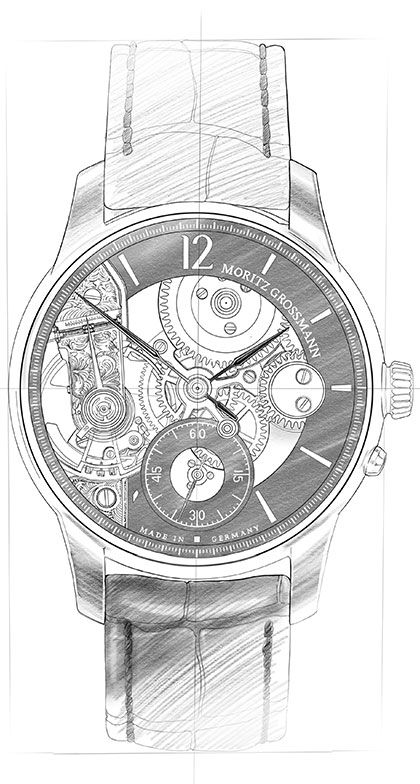
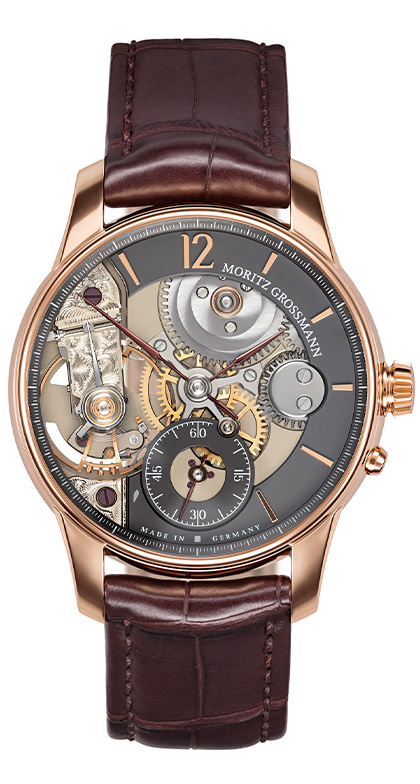
Beneath the dial lies an extraordinarily sophisticated mechanism. Turn the watch over and the hand-wound calibre 100.1 comes into view through the sapphire crystal case back. It is crafted in keeping with the old master’s spirit while also embracing his dedication to innovation and progress. Indeed, the calibre incorporates innovative in-house developments, including a newly engineered oscillator. The clever design of the Grossmann balance allows the moment of inertia to be optimally adjusted during its handcrafted manufacture and achieves high kinetic energy combined with minimised air resistance and the smallest possible mass.
In addition to the ingenious design of the pillar structure, which, like the dial, is crafted from untreated German silver, the meticulous hand-finishing of every component is truly fascinating. For example, the German silver train-wheel bridge has been painstakingly grained by hand to create a particularly even surface. Its edges are bevelled and polished by hand all the way round, adding a subtle gleam.
The balance cock and escape-wheel cock bear a hand-engraved floral pattern. The other surfaces are finished using traditional polishing techniques. The ratchet wheel, for example, features three-band snailing. The movement owes its unmistakable look to white sapphire bearing jewels, set in gold chatons and secured with screws annealed to a brown-violet hue.
The BENU 1878 in stainless steel is the manufactory’s truly distinctive way of carrying on the legacy of its namesake. Limited to just 26 pieces, the special edition combines the history of Glashütte watchmaking with the highest standard of precision craftsmanship and contemporary design.
Moritz Grossmann:
Moritz Grossmann, born in Dresden in 1826, was deemed a visionary among Germany’s great horologists. In 1854, his friend Ferdinand Adolph Lange persuaded the young, highly talented watchmaker to establish his own mechanical workshop in Glashütte. Apart from building a respected watchmaking business, Grossmann was committed to political and social causes. He established the German School of Watchmaking in 1878. Moritz Grossmann passed away unexpectedly in 1885, after which his manufacture was liquidated.
The spirit of Moritz Grossmann’s horological traditions sprang back to life in 2008 when trained watchmaker Christine Hutter discovered the venerable Glashütte brand and had it re-registered. She developed concepts and was inspired by the vision of reviving Grossmann’s legacy more than 120 years later with a particularly exquisite wristwatch. And she convinced private watch enthusiasts to support her in making this dream come true. On 11 November 2008, she founded Grossmann Uhren GmbH in Glashütte.
At Grossmann, gifted watchmakers are preserving traditions without copying historic timepieces. With innovation, superb craftsmanship, a combination of traditional and contemporary manufacturing methods as well as precious materials, they are celebrating ‘Schönstes deutsches Handwerk’ with their timepieces.
